Showing posts with label cultural history. Show all posts

Wednesday, July 09, 2008

A day at the Rijksmuseum Amsterdam

Interviews with the head of the restoring department, a lead restorer for 17th century paintings, a curator/art historian and a physicist. Most of the interviews took place in the atelier (workshop) building. This building was designed by Cruz en Ortiz, who will also be responsible for the new Rijksmuseum. The atelier building is rather white on the inside really. Some rooms have old wooden Cuypers' cabinets giving the clean white rooms character. I'm working on a first draft of an information architecture for the museum's collection: a very difficult job, but an honour to do! I mean, Rembrandt van Rijn's masterpieces will be disclosed by it. I'm enjoying it!

Monday, June 23, 2008

Sunday, January 20, 2008

Library of Congres started a pilot on Flickr

1. Operating a hand drill at Vultee-Nashville, woman is working on a "Vengeance" dive bomber, Tennessee, 2. At the Vermont state fair, Rutland, 3. Retiring a locomotive driver wheel in the Atchison, Topeka, and Santa Fe railway locomotive shops, Shopton, near Fort Madison, Iowa. The tire is heated by means of gas until it can be slipped over the wheel. Contraction on cooling will hold it firmly in p, 4. Shepherd with his horse and dog on Gravelly Range, Madison County, Montana, 5. Parris Island, S.C., barrage balloon, 6. House, Houston, Texas, 7. Southeastern Georgia?, 8. Typical southeastern Georgia farm with newly harvested field of oats, 9. Southern U.S., 10. Typical southeastern Georgia farm with newly harvested field of oats, 11. Georgia oat field? Southern U.S., 12. Harvesting oats, southeastern Georgia?, 13. Cabin in southern U.S., 14. Cabin in Southern U.S., 15. Cabin in Southern U.S., 16. House in southern U.S., 17. Spreading fertilizer from 4-mule team wagon, Georgia, 18. Commuters, who have just come off the train, waiting for the bus to go home, Lowell, Mass., 19. Factory buildings in Lowell, Mass.?, 20. Brockton, Mass., Dec. 1940, second-hand plumbing store, 21. Headlines posted in street-corner window of newspaper off[ice] (Brockton Enterprise) ... Brockton, Mass., 22. Children in the tenement district, Brockton, Mass., 23. Detail of industrial building in Massachusetts, 24. Street in industrial town in Massachusettsz, 25. Lowell, Mass., street, 26. Railroad cars and factory buildings in Lawrence, Mass., 27. Detail of industrial building in Mass., 28. Street scene, possibly in Brockton, Mass., 29. [Children with adult in the tenement district, Brockton, Massachusetts], 30. Industrial buildings and a town in Mass., possibly Brockton, 31. [Train and several sets of railroad tracks in the snow, Massachusetts], 32. Massachusetts farm, possibly around Brockton, Mass., 33. Skating, vicinity of Brockton, Mass., 34. Near the waterfront, New Bedford, Mass., 35. Street corner, Brockton, Mass., 36. Industrial area in Massachusetts, possibly around New Bedford

Monday, October 15, 2007

fraochaidhe

Freaky

from fraochaidhe, strange, unusual; frightening, frenzied, manic, mad, rabid, raving, wild
source: List of English language words of Irish origin, wikipedia.org.

Tuesday, July 03, 2007

What Was Where?

Today the Beta version of www.watwaswaar.nl was presented in Utrecht. The site's back-end was built by Toutatis. Wat Was Waar?, meaning "what was where?" is a website for the broad public showing the map of The Netherlands with all places clickable leading to a list of contents linked to that place in a certain period of time. From 1932 'till today. Currently the contents are aerial photo's, old city designs and information about house or land owners. The map viewer shows really clear and detailed maps, based on vectorized maps. Toutatis developed a smart pre-load mechanism, ensuring maps are shown really fast. Lots of ajax is used. Compliments to Toutatis and WatWasWaar.

Thursday, April 05, 2007

Been there, seen it and got the T-shirt

To be perfectly honest with you, I haven't got the t-shirt. Why? Hadrian wasn't there at the time. A local told us he opens shop at thee o'clock, we were several hours early.

Hadrian's Wall (Latin: Vallum Hadriani) is a stone and turf fortification built by the Roman Empire across the width of Great Britain. It was the second of three such fortifications built across Great Britain, the first being Gask Ridge and the last the Antonine Wall. All three were built to prevent military raids by the tribes of (what is now) Scotland to the north, to improve economic stability and provide peaceful conditions in the Roman province of Britannia to the south, and to physically mark the frontier of the Empire. Hadrian's Wall is the best known of the three because it remains the most physically preserved and evident today. The wall was the northern border of the Empire in Britain for much of the Roman Empire's rule, and also the most heavily fortified border in the Empire. In addition to its use as a military fortification, it is thought that the gates through the wall would also have served as customs posts to allow trade taxation. A significant portion of the wall still exists, particularly the mid-section, and for much of its length the wall can be followed on foot. It is the most popular tourist attraction in Northern England, where it is often known simply as the Roman Wall. It was made a UNESCO World Heritage Site in 1987. English Heritage, a government organization in charge of managing the historic environment of England, describes it as "the most important monument built by the Romans in Britain".
It was windy, chilly and very slipery out there. Very very impressive to be sitting on a wall built in the year 122!

The place to be...when in Ennerdale Bridge that is

Tuesday, April 03, 2007

Major Gowen: "A room with a view, please, Fawlty!"

Major Gowen, played by Ballard Berkeley, in Fawlty Towers was a bumbling, quintessential stiff upper lipped English gentleman. And proud of it! Well known for his distrust of foreigners in general, and Germans in particular, he could always be found wandering about Fawlty Towers enquiring if the newspapers had arrived yet. The only thing more important to Major Gowen than the arrival of the newspapers to keep himself abreast of the cricket scores was the opening of the bar. This was an era with less liberal licensing hours than can be enjoyed in England today.

“We loved this guy who was in his own world. He never quite understood what was going on, but always added his own interpretation of it.” — John Cleese.
For some reason or another I feel like being at Fawlty Towers when staying at our hotel in Cumbria. It's a nice place with friendly and customer-focussed people, but...
An example: [After dinner's main course] "We'd like to order some sweets now please?" "Certainly, I'll be just a moment and get back to you with the daily specials" After several minutes, she returns and says: "We're not serving sweets anymore, the chef's gone home." [bear in mind that it's only 9 o'clock in the evening]
Another one: [Just after midnight, my colleagues telephone rings him out of his sleep] "Yes?" "Oh hello, I'm just calling to tell you that your colleague hasn't arrived yet" "Right, thank you madam and good night" [In this case one of us was coming in late, struggling his way through bad weather with barely any view due to heavy rain, therefore arriving later than the receptionist intended to stay at her desk]

"Art sure, Timothy, 'tis ours? Methinks 'tis but a re-made."

Monday, March 20, 2006

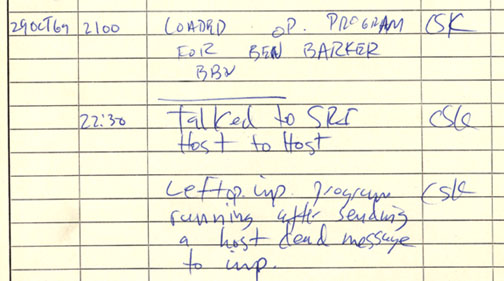
History of internet

Just because I stumbled over it while gathering multimedia retrieval cases I couldn't help myself sharing it with you. An interesting (and kind of funny) video showing the team that developed ARPANet, the predecessor of Internet.Widely circulated photo of the IMP Team (left to right): Truett Thatch, Bill Bartell (Honeywell), Dave Walden, Jim Geisman, Robert Kahn, Frank Heart, Ben Barker, Marty Thrope, Will Crowther, Severo Ornstein. Not pictured: Bernie Cosell.

In late 1968, the Advanced Research Projects Agency (ARPA) put out a Request for Quotation (RFQ) to build a network of four Interface Message Processors (IMPs). At BBN, Frank Heart assembled a proposal team that included Dave Walden, a young programmer with expertise in real-time systems, Bernie Cosell, an ace de-bugger, Severo Ornstein, a hardware ace, Will Crowther, an programmer who specialized in producing complex, tight code, and Bob Kahn, the consummate theoretician who understood error-control and the problems associated with sending data over telephone lines. Source: www.bbn.com
In the video provided by GoogleVideo we can see interviews with: J.C.R. Licklider, Fernando Corbanto, Leonard Kleinrock, Bob Kahn, ... Len Kleinrock's story about the first message over ARPANet:
"A month later the second node was added (at Stanford Research Institute(SRI)) and the first Host-to-Host message ever to be sent on the Internet was launched from UCLA. This occurred in October when Kleinrock and one of his programmers proceeded to "logon" to the SRI Host from the UCLA Host. The procedure was to type in "log" and the system at SRI was set up to be clever enough to fill out the rest of the command, namely to add "in" thus creating the word "login". A telephone headset was mounted on the programmers at both ends so they could communicate by voice as the message was transmitted. At the UCLA end, they typed in the "L" and asked SRI if they received it; "got the L" came the voice reply. UCLA typed in the "O", asked if they got it, and received "got the O". UCLA then typed in the "G" and the darned system crashed! Quite a beginning. On the second attempt, it worked fine!"

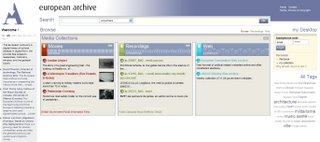
European Archive

The European Archive is a non-profit foundation working towards universal access to all knowledge. The archive will achieve this through partnerships with libraries, museums, other collection bodies, and through building its own collections. The primary goal of collecting this knowledge is to make it as publicly accessible as possible, via the Internet and other means.

Rationale With the Internet, tremendously rich parts of our cultural heritage could be freely accessible online. But most of them are still dormant (non-digitized collections) or disappearing (Web history). Massive digital collecting, digitizing, and storage techniques make it possible to preserve and give public access to this rich material. Mastering these techniques will be key in the coming years for the future of cultural heritage, both traditional and materials produced in digital form. Europe, cradle of a unique cultural heritage has a special role to play to this regard. But even in a connected world, propinquity, specific legal and technical environment should not be underestimated and having a European-based institution in this domain makes a difference. By developing a large-scale archiving architecture in Europe and competences that come with it, the European Archive intends to be a catalyser in the development of skills and know-how in the domain of preservation and access to digital collections. It also intend to bring in Europe a new type of Cultural Institution that focus to free public access to large rich digital collections. Web archiving As the web has grown in importance as a publishing medium, we are behind in bringing into operation the archiving and library services that will provide enduring access to many important resources. Where some assumed web site owners would archive their own materials, this has not generally been the case. If properly archived, the Web history can provide a tremendous base for time-based analysis of the content, the topology including emerging communities and topics, trends analysis etc. as well as an invaluable source of information for the future.
The foremost effort to archive the Web has been carried on in the US by the Internet Archive, a non-profit foundation based in San Francisco. Every two months, large snapshots of the surface of the web are archived by the Internet Archive since 1996. This entire collection offers 500 terabytes of data of major significance in all domain that have been impacted by the development of the Internet, that is, almost all. This represent large amount of data (petabytes in the coming years) to crawl, organize and give access to.
By partnering with the Internet Archive, the European Archive is laying down the foundation of a global Web archive based in Europe. Digitization We have entered an era where digitization of all significant cultural artefacts will be completed. Within the next decade, most of the published cultural content (books, music, images and moving images) will have been digitized. Recent commercial announcements have fostered awareness and started this movement, but limited to a few major libraries which leaves an opportunity for an open system to be pursued. This entails digitizing, preserving and providing access to the rich public domain of books, music, images and moving images on a the large scale. By fostering the development of a large scale, archiving platform, the European Archive intend to facilitate the mastering of processes and tools needed for digital public content archiving and distribution in Europe. Infrastructure With the technical support of the Internet Archive and XS4ALL, the European Archive has installed a repository with 250 terabytes (250 000 giga-bytes) capacity in Amsterdam via which a large collection digital material (text, music, moving images, software) can be accessed. On average, the download rate has been over 350 Megabits per second in December 2005, already making EA a significant content provider in Europe. The data organization is highly distributed (200 nodes on a cluster) to enable distributed processing. This achievement represents already a significant step in establishing in Europe an archiving infrastructure to collect and archive digital material at large scale. We plan to extent it to 1 petabyte (1000 terabytes) within the coming years. The European Archive should be accessible in Europe’s language. A multilingual web management system for large digital collections has been implemented. This system is based on a flat structure permanently indexed and updated. It allows light and flexible management of the web interface to collections, and can scale up unlimitedly in the future. An opportunity for Europe We expect the European Archive to become an essential piece in the European cultural heritage landscape. In order to meet the goals of Lisbon 2010 for Europe to become
“the most dynamic knowledge economy in the world”
large-scale public archive is a key component. It will enable public and free access to large portion of European cultural heritage and bring in the broadband network infrastructure tremendous quantity of rich and legal content. It will bring to traditional heritage institutions a technology partner enabling them to make significant steps towards digitization and public accessibility of their collections, making Europe more visible and attractive in a globally networked world. By developing cutting hedge technology application in the domain of massive digital collection acquisition, management and storage it will develop a centre of excellence in a key domain of tomorrow’s Internet.

Munch: Video Retrieval system for Dutch national video archive

Multimedia aNalysis for Cultural Heritage (MuNCH). MuNCH focuses on knowledge enrichment by means of automated analyses of digital images and video. With the advent of digital communication, we live in the exciting times of broad and narrow casting through the Internet, of passive and active viewers, of direct or delayed broadcast, and of digital pictures being delivered in the museum or at home. At the same time, the picture and television archives turn digital. In these demanding times, the archives are likely to be swamped with information requests unless they swiftly adapt to partially automatic annotation and digital retrieval. The aim of this project is to provide faster and more complete access to pictures in cultural archives through digital analysis. MuNCH is a project of the University of Amsterdam, the Vrije Universiteit Amsterdam, the Netherlands Institute for Sound and Vision and the association Digitaal Erfgoed Nederland. Projectleader is Arnold Smeulders. Intelligent Systems Lab Amsterdam on the project:

In the MuNCH project - part of the CATCH projects by NWO - we aim to deliver a working video retrieval system to the Beeld en Geluid national (video)archive. A first version is planned for at the end of 2006 making use of the engines for video analysis and interaction. In the MuNCH, we cooperate with Maarten de Rijke (UvA) on natural language processing, with Guus Schreiber (VU) on ontologies of video material, and of course with The Netherlands Institute for Sound and Vision, Annemieke de Jong providing the content (essence + metadata).
Participants of Intelligent Systems Lab Amsterdam are:
  • Jan van Gemert
  • Jan-Mark Geusebroek
  • Arnold Smeulders (contact MuNCH)
  • Cees Snoek (contact TRECVID)
  • Marcel Worring (contact MediaMill)

MultiMatch: multilingual/multimedia access to cultural heritage

Our shared cultural heritage (CH) is an essential part of our European identity, transcending cultural and language barriers. The MultiMATCH project will enable users to explore and interact with online CH content, across media types and language boundaries, in ways that do justice to the multitude of existing perspectives.

The MultiMATCH search engine will:
  1. crawl the Internet to identify websites with CH information, locating relevant texts, images and videos, regardless of the source and target languages used to write queries and describe the results;
  2. automatically classify the results in a semantic-web compliant fashion, based on document content, its metadata, its context, and on the occurrence of relevant CH concepts in the document;
  3. automatically extract relevant information which will then be used to create cross-links between related material, such as the biography of an artist, exhibitions of his/her work, critical analyses, etc.;
  4. organize and further analyse the material crawled to serve focused queries generated from user-formulated information needs;
  5. interact with the user to obtain a more specific definition of initial information requirements; and finally organize and display search results in an integrated, user-friendly manner, allowing users to access and exploit the information retrieved regardless of language barriers.
MultiMATCH will combine the advantages of both generic and specialised search facilities: it will be automatically updated via regular focusedcrawling of relevant web sites, and does not involve costly maintenance for manual indexing, classification or annotation of data. The system will be designed to support diverse user classes but also to assist CH institutions to disseminate their content widely and raise their visibility. MultiMatch is an IST-2005-2.5.10 project (Access to and preservation of cultural and scientific resources) and involves 11 teams from around Europe. Within the Amsterdam team, the people involved are:
  • Jaap Kamps
  • Maarten de Rijke
  • PhD student
  • PhD student
  • Postdoc
Content will be provided by Johan Oomen, The Netherlands Institute for Sound and Vision.

Culture around the Corner

Information about the nearest cultural event, museum or monument on your mobile phone, Personal Digital Assistant (PDA) or laptop is no longer something of the far future. ZaPPWeRK is initiator of Culture around the Corner and selected parties to participate in this innovative project. The service works via text messaging or, technically more advanced, the mobile portal Vodafone life! where "Steetguide" indicates the exact location of the nearest building of interest. The website www.cultuurindebuurt.nl can be consulted via PDA and laptop. Whatever instrument you use the system retrieves your position automatically and matches your location with the location of the required place of interest.

Sunday, March 19, 2006

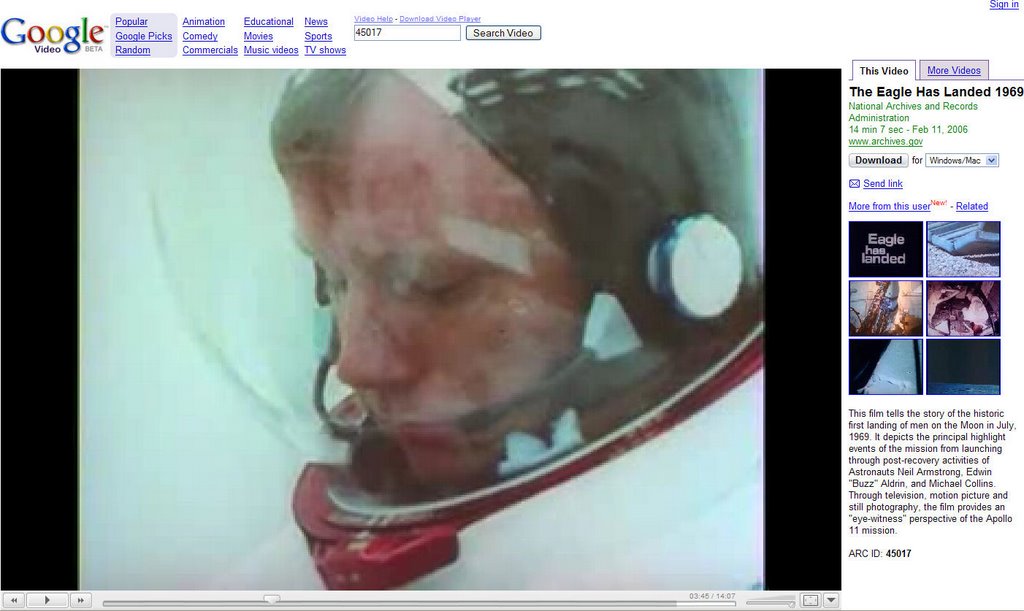
National Archives and Google Launch Pilot Project to Digitize and Offer Historic Films Online

National Archives and Google Launch Pilot Project to Digitize and Offer Historic Films Online Washington, D.C. and Mountain View, Calif. – Feb. 24, 2006 – Archivist of the United States Allen Weinstein and Google (NASDAQ:GOOG) Co-Founder and President of Technology Sergey Brin today announced the launch of a pilot program to make holdings of the National Archives available for free online. The eagle has landed, 1969. This non-exclusive agreement will enable researchers and the general public to access a diverse collection of historic movies, documentaries and other films from the National Archives via Google Video as well as the National Archives website." source: NARA Press/www.archives.gov

Wednesday, March 15, 2006

Quaero's 'stunningly ambitious' technological goals

That’s what The Economist wrote on March 9, 2006 in an article heading:” Search technology: Can an ambitious new European search engine, backed by the governments of France and Germany, challenge Google?” On various blogs people discuss Quaero, so do I. A great many of them state that the way Quaero will compete (as if) with Google and Yahoo! is unfair, since the French and German governments are pumping enormous funds into the collaborative economic effort in the image of the success of Airbus. Well, so what! Isn’t the American software industry built upon the previous investments of its governmental projects like DARPA and NASA? Google being a private company today, doesn’t mean it did ever profit from governmental funds, didn’t Page and Brin study at Stanford, and doesn’t Stanford still hold the patents on the ranking mechanism… I rest my case. Far more interesting than French/German – American competition, is the scientific side of Quaero, that is: investing in building a new body of knowledge about multimedia retrieval. Really pushing the envelope of information retrieval by developing new technology to be able to incorporate other than text-based search mechanisms. Searching by example, with an image as example! One of the french project partners called LTU Technology is already working on it quite some time, now they have the opportunity to get to the next level. And so does the German research team at the university of Karlsruhe, working on speech-based algorithms. The latter are focussed on speech-based retrieval. Furthermore, think of the massive impact on the multiliguality of the web by propagating keywords. Say two images match based on image properties, the one has english metadata the other french metadata, through propagation of these metadata onto eachother (in the index) both pictures will become retrievable in both languages. That’s kick-ass innovation. Let’s give Quaero a chance. Luckily Mrs. Merkell backs the initiative of her predecessor Schroeder, so politics didn’t get in the way during the german government’s transition. Let the researchers do their work, don’t let Quaero get in harms way before something is actually built. It’s not about competing, it’s about a next leap in retrieval, multi media retrieval! PS Quaero has one advantage on Google and alike, it doesn’t have difficult business models underneath, just like Google when it was still a project at Stanford some ten years ago being nurtured by ambitious students called Larry Page and Sergey Brin.