The importance of failure
If at first you don't succeed from Ben Fry on Vimeo.
Last Friday I attended The Next Web Salon for the second time in a row. Got to meet interesting people and got triggered by the 10 minute presentation by Michael Bauer. Michael Bauer is a local internet expert and CEO of Koano. Michael's presentation, though very short but nevertheless good, was about the future of local. Local as in: Search, Mapping, Ontology, International, Social, Network.
Imagine a web app that allows me as a citizen of Amsterdam to find the kind of places I know and like in Amsterdam when I travel abroad. E.g. Vondelpark in Amsterdam, is similar to, Central Park in New York. A recommendation system based on things you know well near your 'home' to find things near your 'locus' (the place you are).
 What would be the impact of such a mechanism in an enterprise context? In large organisations where it's beyond your possibilities to know everything, but you do know your thing. So, what if the coordinates are not geographic, but organisational. Your place in the value chain, business process, organogram, stakeholder network, ...
In the pit of my gut I feel there is something good about this...
(Photo taken by Anne Helmond)
What would be the impact of such a mechanism in an enterprise context? In large organisations where it's beyond your possibilities to know everything, but you do know your thing. So, what if the coordinates are not geographic, but organisational. Your place in the value chain, business process, organogram, stakeholder network, ...
In the pit of my gut I feel there is something good about this...
(Photo taken by Anne Helmond)

SKYBRARY: A WIKI FOR AVIATION SAFETY KNOWLEDGE
EUROCONTROL, an intergovernmental aviation industry body, is committed to making European aviation safer, more secure and more environmentally friendly. That means providing a forum where civil and military aviation specialists can learn from safety lesson promotion and best practice dissemination. With that in mind, EUROCONTROL is now in the final stages of creating “SKYbrary”, a wiki for aviation safety knowledge. Here, my colleague Eelco Kruizinga (DNV) and EUROCONTROL's project manager Tzvetomir Blajev tell KM Review readers about this ambitious and forward-thinking KM project.
KM Review Vol 11 Issue 2 May/June 2008 (Melcrum).
Discovery Channel is the place to be when you want to stay in and learn something the easy way, cosy laying on your couch. Well, doing so, I learned something about building rockets to launch satellites to orbit. The programme addressed some issues the Japanese were facing during the build of the HII-B (H2B). Japan launched its first satellite to orbit with licenced American rockets in 1970. Since then they chose the path of liquid fueled rockets as launchers. Leading to the first successful launch of a satellite to orbit in 2005 with the H-IIA rocket. 35 years of development!
 In 2004 they started developing the H-IIB rocket. This rocket is much larger able to carry a much heavier payload. The aim of the rocket is to carry the H-II Transfer Vehicle, or HTV. A robotic spacecraft intended to resupply the Kibō Japanese Experiment Module (JEM) on the International Space Station, and the rest of the station, if need be. Scheduled to be launched in 2009, carrying 16.5 tons. 35 years kept me busy for a couple of days. 35 years spans a full carreer of a space engineer, I guess. So quite some engineers joined and retired during those years. How do they ensure knowledge and experience is retained? In this domain a failed launch means years of delay and millions down the drain. You can't just launch another one the next day... Since 2004 they invested €150 million ($150 billion).
Yesterday I participated in a knowledge cafe by presenting a project I undertook with my colleague Eelco Kruizinga. The project was called SKYbrary, a mediawiki-based reference site for air traffic controllers initiated by EUROCONTROL / Safety Improvement Sub Group, with ICAO and Flight Safety Foundation as participating organisations.
The knowledge cafe had over 70 guests that afternoon, from all walks of trade. All interested in learning about the cases presented and the discussions facilitated about corporate wikis. The other cases were Railpedia by Prorail and ING Wiki by ING Bank.
The location were the knowledge cafe took place is called "Bomencentrum." A small meeting centre on the premises of an arboretrum annex tree farm. A building designed following Feng Shui architecture guidelines, ensuring it's a healthy place where one feels at ease.
View Larger Map
As a present all participants received a Ginkgo Biloba tree. A beautiful and rather specific tree, in many ways.

 As humans we have the capacity to remember and to forget. For millennia
remembering was hard, and forgetting easy. By default, we would forget.
Digital technology has inverted this. Today, with affordable storage,
effortless retrieval and global access remembering has become the default,
for us individually and for society as a whole. We store our digital photos
irrespective of whether they are good or not - because even choosing which
to throw away is too time-consuming, and keep different versions of the
documents we work on, just in case we ever need to go back to an earlier
one. Google saves every search query, and millions of video surveillance
cameras retain our movements.
In this article Viktor Mayer-Schönberger analyses this shift and links it to technological innovation and information economics. Then Viktor suggests why we may want to worry about the shift, and call for what he terms data ecology. In contrast to others he does not call for comprehensive new laws or constitutional adjudication. Instead proposes a simple rule that reinstates the default of forgetting our societies have experienced for millennia, and shows how a combination of law and technology can achieve this shift.
Viktor Mayer-Schönberger is Associate Professor of Public Policy at the John F. Kennedy School of Government / Harvard University. His work focuses on business, legal, and policy issues of the new economy. He is also an expert on the European Union, especially its regulatory framework and business-government relations.
As humans we have the capacity to remember and to forget. For millennia
remembering was hard, and forgetting easy. By default, we would forget.
Digital technology has inverted this. Today, with affordable storage,
effortless retrieval and global access remembering has become the default,
for us individually and for society as a whole. We store our digital photos
irrespective of whether they are good or not - because even choosing which
to throw away is too time-consuming, and keep different versions of the
documents we work on, just in case we ever need to go back to an earlier
one. Google saves every search query, and millions of video surveillance
cameras retain our movements.
In this article Viktor Mayer-Schönberger analyses this shift and links it to technological innovation and information economics. Then Viktor suggests why we may want to worry about the shift, and call for what he terms data ecology. In contrast to others he does not call for comprehensive new laws or constitutional adjudication. Instead proposes a simple rule that reinstates the default of forgetting our societies have experienced for millennia, and shows how a combination of law and technology can achieve this shift.
Viktor Mayer-Schönberger is Associate Professor of Public Policy at the John F. Kennedy School of Government / Harvard University. His work focuses on business, legal, and policy issues of the new economy. He is also an expert on the European Union, especially its regulatory framework and business-government relations.
Combines Wiki, Blog, Sharing information, and much more. Very good value for money for a starting knowledge and information management project in an organisation. Try the demo yourself



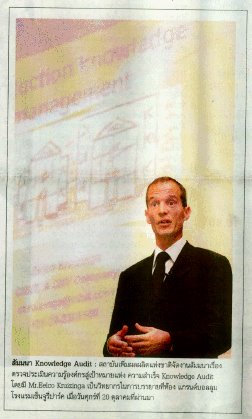
 A friend of mine made it to the Thai Business Newspapers having teached knowledge management audit techniques to a large group of asian businessmen. The conference was organised by the Asian Productivity Organisation.
Wally Wallington has demonstrated that he can lift a Stonehenge-sized pillar weighing 22,000 lbs and moved a barn over 300 ft. What makes this so special is that he does it using only himself, gravity, and his incredible ingenuity.
