Semantic technologies encode meanings separately from data and content files and separately from application code.
This enables machines as well as people to understand, share and reason with them at execution time. With semantic technologies, adding, changing and implementing new relationships or interconnecting programs in a different way can be just as simple as changing the external model that these programs share.
With information technologies, on the other hand, meanings and relationships must be predefined and “hard wired” into data formats and the application program code at design time. This means that when something changes, or we want exchange information we hadn’t previously, or two programs need to interoperate in a new way, the humans must get involved.
Off-line, the parties must define and communicate between them the knowledge needed to make the change, and then recode the data structures and program logic to accommodate it, and then apply these changes to the database and the application. Then, and only then, can they implement the changes.
Semantic technologies are “meaning-centered.” They include tools for autorecognition of topics and concepts, information and meaning extraction, and categorization. Given a question, semantic technologies can directly search topics, concepts, associations that span a vast number of sources.
The results are fast, relevant, and comprehensive. Plus, semantic technologies can deliver answers, not just lists of sources. Information technologies are data, page, and document centered. They can only directly search these primary sources, by browsing, by word or number indices, or with statistical categorization. Precision and recall is more limited, plus information technologies only return lists of pages, documents, and files to consult.
Semantic technologies organize meanings using taxonomies, ontologies and knowledgebases. These are relatively easy to modify for new concepts, relationships, properties, constraints and instances.
Semantic technologies integrate data, content, applications, and processes via a shared ontology, which minimizes costs and effort to develop and maintain.
Information technologies organize meanings using flat files (simple schemas), relational data models (RDBMS), and object-oriented models (OODBMS). Database structure is relatively rigid, and difficult to modify for new concepts and relationships. Integration of data and processes typically requires point-to-point interfaces and connectors that are costly to develop and maintain since the knowledge required must be hard coded in each connection rather than shared via a common metamodel.
Semantic technologies reason via associations, logic, constraints, rules, conditions, and axioms that are represented in the ontology separately from application code. This declarative structure allows reasoning in multiple directions. For example the same knowledgebase can be used to answer questions about how, why, and what-if as well as give factual responses.
Also, semantic technologies allow development of programs that can “learn” (infer and create new knowledge) simulate and test, and adapt behavior based on experience.
Information technologies reason via fixed algorithms that are embedded in application code. Information technologies give us situation awareness. For example, they answer questions about what, where, when, and how much.
Algorithms are preprogrammed behaviors, like instinct. They perform a rote task. If anything is learned, people must update the logic off-line to create a new version of the program.
Semantic technologies use ontologies to auto-discover and provision services and functionality (e.g., semantic web services, semantic grid services, etc.). They use ontologies to link applications into composites that deliver a comprehensive (e.g., virtual, 360 degree) view of situations with all data and information in context. By representing meanings in a language and media neutral form, semantic technologies can auto-generate text, graphics, drawings, documents, and natural language dialogs. Similarly, they can auto-personalize, customize, and generate multiple versions of communications from the same knowledgebase automatically.
Semantic technologies enable “autonomics:” systems with self-knowledge that can selfconfigure, self-optimize, self-protect, self-heal, and self-manage. They provide the foundation for developing new categories of services and products that can know, learn, and reason as humans do.
Information technologies require humans to manually discover and implement data and application connections and interfaces. Alternatively, humans must search to find data and information, and then put it into the right context for decision-making. Information technologies use computers as “electronic pencils” for humans author and develop content, visuals, and media formats.
 Currently we are getting surrounded by people calling themselves Information Architect. Hell, yeah, I call myself one!
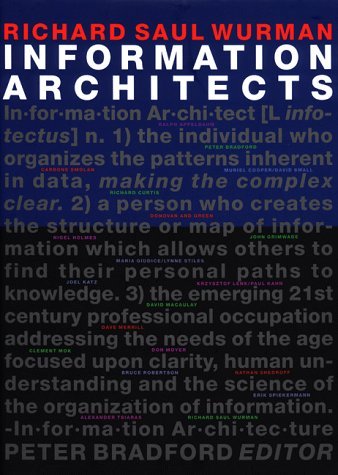
So where did that word come from? Quite some years ago (1997) I happened to be working on a project with John Thackara in Amsterdam. Bringing together people from two different fields: knowledge management and (interface) design. From the world of design we had quite an odd bunch of people: io360 from NY, Perspecta from Cambridge MASS, PlumbDesign, ... those people got me thinking about, what we call now IA. I asked one of them what his favorite book was on (interface) design, this happened to be INFORMATION ARCHITECTURE by RICHARD SAUL-WURMAN.
Today we would call Richard's ideas Information Design, but still, his ideas come quite close to IA of today. As Christina Wodtke put it quite right: Pretty much before there was a web, before Jakob was going to war with design, before all that hoo-haw... There was Richard Saul Wurman saying that someone should design information in a way people could use it, and he called this person an Information Architect.
Currently we are getting surrounded by people calling themselves Information Architect. Hell, yeah, I call myself one!
So where did that word come from? Quite some years ago (1997) I happened to be working on a project with John Thackara in Amsterdam. Bringing together people from two different fields: knowledge management and (interface) design. From the world of design we had quite an odd bunch of people: io360 from NY, Perspecta from Cambridge MASS, PlumbDesign, ... those people got me thinking about, what we call now IA. I asked one of them what his favorite book was on (interface) design, this happened to be INFORMATION ARCHITECTURE by RICHARD SAUL-WURMAN.
Today we would call Richard's ideas Information Design, but still, his ideas come quite close to IA of today. As Christina Wodtke put it quite right: Pretty much before there was a web, before Jakob was going to war with design, before all that hoo-haw... There was Richard Saul Wurman saying that someone should design information in a way people could use it, and he called this person an Information Architect.